Nothing to wine about
As a gal who’s spent the last two decades serving and managing in natural wine bars, breweries, and restaurants, (and as someone who loves a good drink), I love paying attention to what’s filling everyone’s cup. The industry skips from hoppy IPAs to buttery Chardonnays to “natty” chilled reds, filthy martinis, and on and on.
Lately, we hear rumors of younger generations drinking less. But while beer and spirits have adapted and found new ways to stay relevant (think canned cocktails), you see the wine industry clutching its grapes. The thing is, the industry isn’t tanking, it’s simply evolving, like it always does.
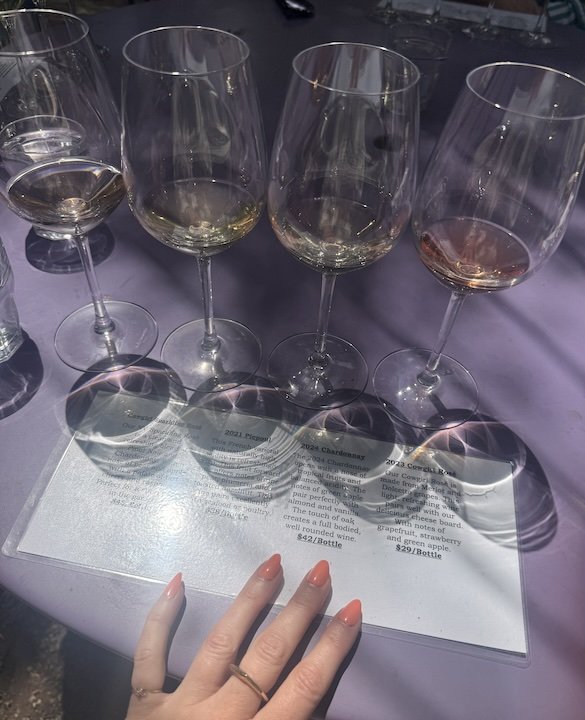
Tasting Flight @ Cowgirl Winery, Carmel Valley, CA
Pick Me! Pick me!
Walk down the booze aisle and colorful cases of beer and canned spritzes fill the refrigerated shelves saying: “Pick me! I’m for the beach! I’m for after work! I’m cold! I’m $10!”
And a $28 bottle of wine says: Chateau Something Something, 2018 Russian River Pinot Noir.
Unless you already possess the vocabulary, knowledge, context, wine key, glassware, and desire to consume the whole thing within a few days, you can see which option becomes the easier one to grab.
Wine is treating a branding problem like a demand problem.
Historically, wine has benefitted from a certain amount of mystique, but paired next to something with a little less fuss, that mystique starts to feel like it’s playing just a little too hard to get.
Sometimes I’ll be drawn to pick up a bottle of wine, only to look closer at the label and find almost no information beyond the name and ABV%. No story. No notes. You can’t judge a book by its cover if there isn’t one.
The funny thing is, wine has more storytelling material than most products: geography, traditions, farming, climate, weird grape varieties. It’s is loaded with story and then bizarrely reluctant to tell it.
Bet that sediment has something to say.
More Than a Bottle
At Botanica, in LA, where I was working earlier this year, we stocked one wine that everyone fell in love with. No bottle—just an upright silver pouch with handles and a spout. It sat cheerfully on the shelf with an illustration of a dog on the front and became the go-to choice for someone headed to a dinner party.
At $35 for a 1L bag, it was yummy on many levels.
Its only downside was the way it came to us from the distributor: stacked pouches inside a cardboard box. One day, I used a box cutter to open a case and sliced right into one of the pouches, gushing wine onto the floor. Sad moment.
This particular wine was a natural orange. It was novel, affordable, and shareable. I do love natural wines, and they’ve made a big splash over the last decade or so. New producers, labels, grapes, colors, and flavors introduced a new visual language and attitude of wine, though it still seems to remain tucked into a cultural niche.
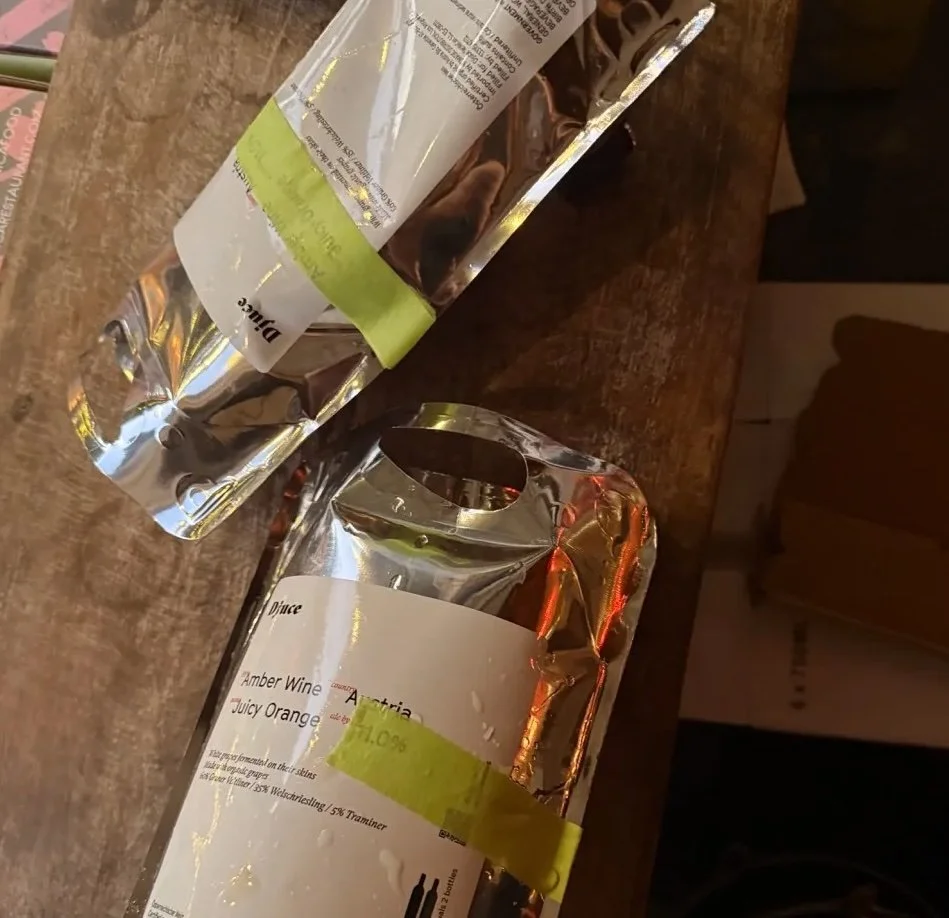
Wine surgery to save D’juce.
What I think natural wine has done right is brand less around the grape and more around the moment.
It’s fun to grab a bottle filled with bright pink wine and sediment that looks like it was sampled from the moon, bring it to a party, and say: “Let’s try this!”
Grape Gripes
There’s one final thing that sits beyond story, product, and packaging: presentation. How it’s served.
When it comes to ordering a glass of wine at a restaurant, the guest is thinking without thinking:
Will it be cold? Will it be fresh? Will the server know the appropriate pour size?
Beer and cocktails are generally consistent, thanks to kegs and jiggers. Wine can vary a lot from place to place, and server to server.
Recently, I had a refreshing Mommenpop wine spritz on tap, over ice. In fact, I had three of them. And the law of diminishing returns did not seem to apply.
Colorful bottles of Mommenpop.
I wasn’t expecting to fall in love with wine on tap, but I realized that simple spout solved nearly all of my usual gripes about ordering wine out.
It reminded me of a trip to Boise, Idaho several years ago, when a friend took me to Bodovino. Think wine bar meets automat.
The host would help you load money onto a card, and then you could wander through the space, walk up to a machine, and select a taste, half pour, or full pour. It was fun and futuristic, although a little sterile and lacking some of the warmth you want when going out. The service was almost completely removed from the experience.
Funny enough, Bodovino closed in 2024, but the sushi restaurant that took over the space kept the wine machines because they had been such a draw for guests.
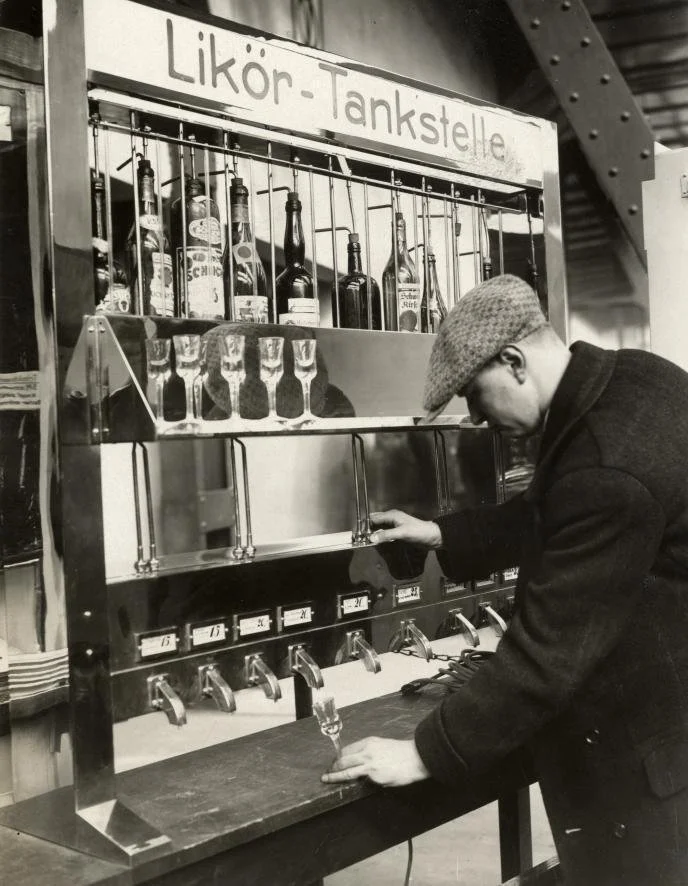
Liquor vending machine at the Leipzig Fair, Germany, 1931. National Archives of the Netherlands / Spaarnestad Photo.
A Few Notes for the Wine Industry
Okay, all my wine-ing aside, I don’t think the wine industry needs to abandon tradition or the things that make wine wine. It just needs to get more curious about what people want and how they want to drink now.
DO:
Tell the story. Loud and clear.
Collaborate. Like Norah Jones did.
Get into more taps.
DON’T:
Give every wine the same label.
Complain that people aren’t drinking wine. Get curious.
Be afraid to change the format. Half bottles? Everyone loves a mini.
me circa 2019 serving @ jeune pop up in Sacramento, CA